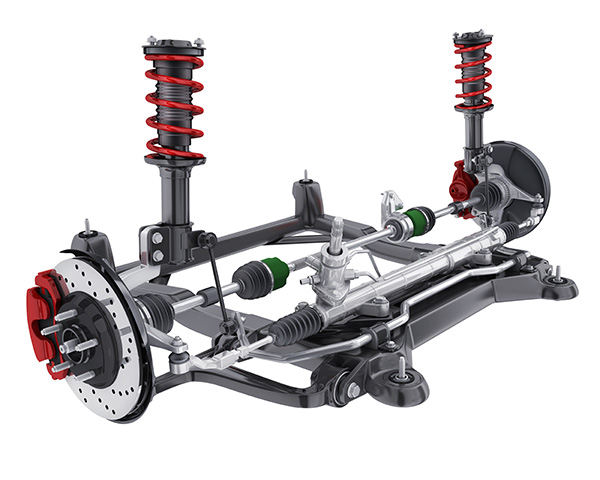
A sway bar reduces excessive body lean by linking the left and right sides of a vehicle’s suspension. When the vehicle enters a turn, weight shifts toward the outside tires. The outside suspension compresses while the inside suspension extends, causing the body to lean away from the direction of the turn.
The sway bar twists as the two sides move differently and resists part of that motion. This helps the vehicle respond more directly to steering input, settle faster during direction changes, and maintain a more controlled position through corners. It is also known as an anti-roll bar or stabilizer bar.
How a Sway Bar Works
A sway bar is usually a solid or hollow steel bar mounted across the front or rear suspension. Its center section is secured to the chassis or subframe with bushings and brackets. Each end connects to the suspension through a sway bar link.
When both wheels rise or fall together, such as when crossing a broad dip, the bar twists very little. Each side of the suspension can move through much of its normal travel. When one wheel rises and the other falls during cornering, the bar twists and creates resistance.
The bar does not eliminate weight transfer. Vehicle weight still moves toward the outside tires because of speed, steering angle, center of gravity, and road conditions. Instead, the bar controls how the suspension responds to that transfer and limits excessive difference between the left and right sides.
Why Reduced Body Roll Improves Stability
Excessive body movement can make steering feel delayed because the vehicle leans before fully responding to the driver’s input. A properly sized sway bar helps the body reach a stable position sooner, which can make cornering feel more predictable.
Roll control is especially useful during highway lane changes, curved ramps, quick obstacle avoidance, and repeated turns. Keeping the body more level can also help suspension geometry remain closer to its intended range as the wheels move.
A sway bar cannot create traction beyond the limits of the tires. Tire compound, tread condition, pressure, alignment, road surface, and vehicle speed still determine how much grip is available. The bar helps manage that grip by influencing how load is distributed across the tires during a turn.
Front and Rear Bars Affect Cornering Balance
Changing sway bar stiffness alters how the front and rear tires share cornering work. A stiffer front bar generally reduces front body roll, but it can also make the front tires reach their traction limit sooner. The vehicle may then resist turning and travel toward the outside of the corner.
Increasing rear sway bar stiffness can help the vehicle rotate more readily by shifting cornering balance toward the rear. Too much rear stiffness, however, can make the back of the vehicle less stable during sudden steering, braking, or slippery conditions.
Manufacturers select front and rear bar sizes based on vehicle weight, drivetrain, suspension design, tire size, and expected use. Performance changes should be made as a balanced package. Installing the largest available bar does not automatically produce the strongest handling result.
Bar Diameter, Shape, and Mounting Position
Sway bar stiffness is influenced by more than appearance. Diameter has a major effect, but wall thickness, material, shape, arm length, and mounting location also change how strongly the bar resists twisting.
Some aftermarket bars include several link mounting holes. Moving the link changes the bar’s effective lever arm and allows stiffness adjustment. A shorter effective arm generally creates greater roll resistance, while a longer setting provides a softer response.
Adjustable bars are useful when a vehicle serves several purposes, but the settings should remain appropriate for its tires, suspension, and normal driving environment. A setup intended for track use may feel harsh or react too quickly on rough public roads.
Sway Bar Links and Bushings Are Essential
The bar cannot function correctly if its links, bushings, or brackets are loose. Sway bar links transfer movement between the suspension and the bar. Their ball joints or rubber bushings wear as the suspension moves over bumps and through turns.
Center bushings hold the bar in position while allowing it to twist. Worn bushings can let the bar shift from side to side, reducing response and creating noise.
Common signs of worn components include:
- Clunking over small bumps
- Rattling on uneven pavement
- Squeaking as the body moves
- Loose or delayed cornering response
- Visible play in a link
- Cracked or displaced bushings
- A broken mounting bracket
These symptoms can overlap with worn control arm bushings, strut mounts, ball joints, tie rods, or shocks. An inspection should cover the complete steering and suspension system before repairs are selected.
Can a Sway Bar Make the Ride Too Firm?
A sway bar primarily resists opposite-side suspension movement, so it affects cornering more than straight-line ride quality. However, a very stiff bar can make bumps that affect only one wheel more noticeable because it transfers more force to the opposite side.
On rough roads, excessive stiffness can reduce independent wheel movement and make it harder for both tires to remain planted. This is one reason off-road vehicles sometimes use sway bar disconnects to increase suspension articulation at low speed.
The strongest setup balances body control with tire contact and comfort. Springs, shocks, struts, bushings, tires, and alignment all influence the final result. A sway bar should complement those components rather than compensate for worn or incorrectly selected parts.
Maintaining Reliable Roll Control
Sway bars themselves often last for many years, but links and bushings may need replacement sooner. Regular maintenance visits provide opportunities to check for looseness, torn boots, worn rubber, corrosion, and damaged brackets.
Fasteners must be tightened correctly, and replacement bushings must match the bar diameter. Adjustable links may be needed on lowered vehicles or modified suspensions so the bar is not loaded unevenly while the vehicle is sitting level.
Get Sway Bar Service In Walnut Creek, CA, With Prestige Autohaus
Prestige Autohaus can evaluate sway bars, links, bushings, shocks, struts, control arms, alignment, and tire condition.
Contact us to schedule service in Walnut Creek, CA, if your vehicle leans excessively, clunks over bumps, or feels less controlled through corners.